
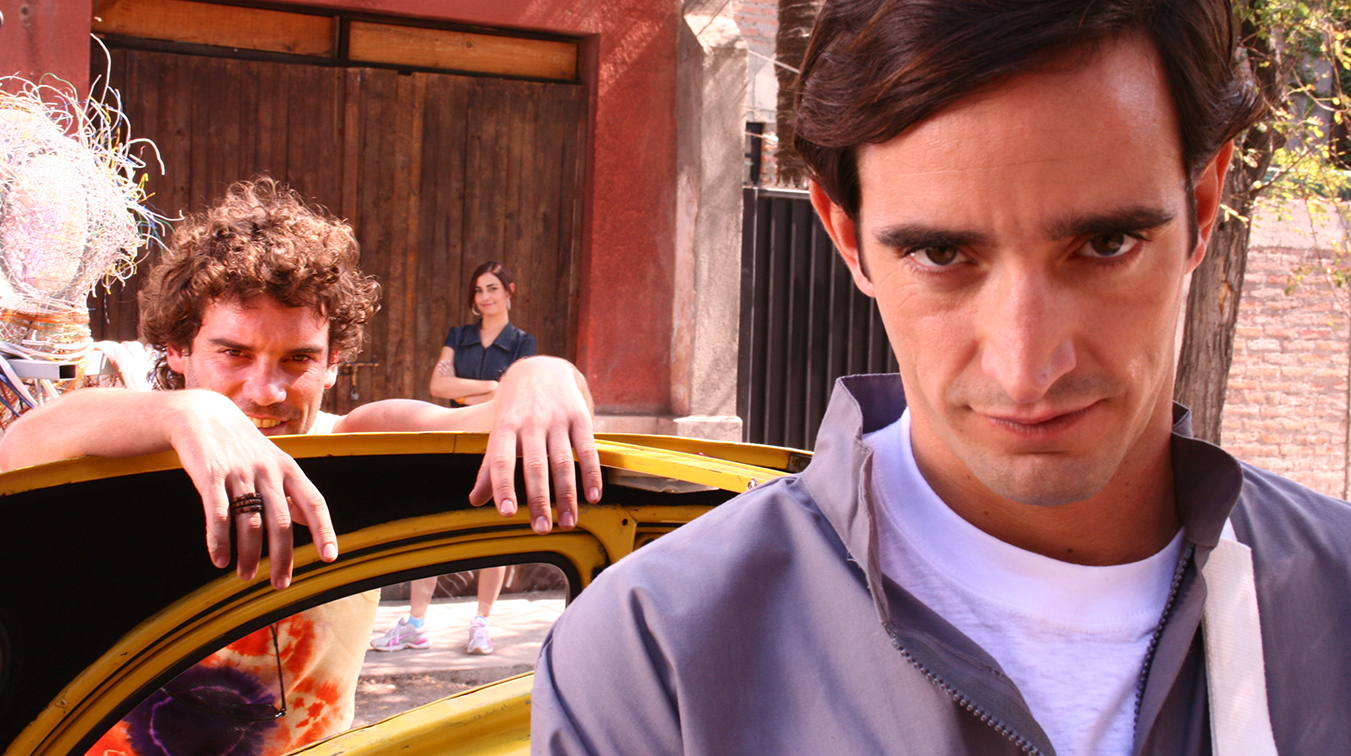
Starting today and until next Thursday, September 3rd, we are sharing two films that take a look at Chilean idiosyncrasy through a humorous lense: one a fictionalized account of friendship and the other from a documentary point of view. Through Scrambled Beer by Cristóbal Valderrama and The Hairdressers by Maite Alberdi & Israel Pimentel, we are delving into two stand out works from the 2007 Chilean film scene. This period is characterized by the development of New Chilean Cinema, key to laying the foundations of an innovative and emerging industry that managed to captivate the attention of the entire world.
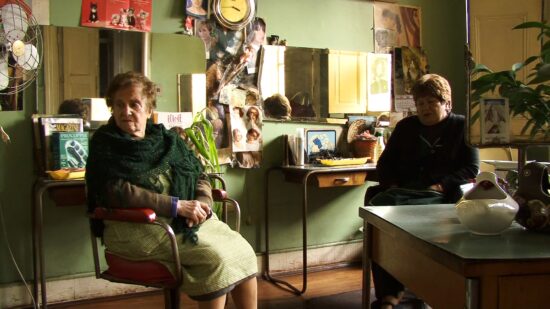
In Scrambled Beer, elements of black comedy help build a youthful universe where strange occurrences blur the line between the real and the fantastic. It tells the story of two friends who go to live together and involuntarily travel through time. In The Hairdressers identity and friendship is explored through Ana Luisa and Tato, two friends who meet daily in their community's salon, a place that is a refuge amidst their transforming neighborhood. Both films are a character study, looking at how friendship ties are linked to customs, exploring the relationship between our surroundings and kinship.
CLICK TO SEE MALTA WITH EGG
CLICK TO SEE THE HAIRDRESSERS
Scrambled Beer, Valderrama's opera prima, stars Diego Muñoz, Nicolás Saavedra, Javiera Díaz de Valdés and Manuela Martelli. With intelligent and insightful humor loaded with irony, it follows two friends who move in together, each one experiencing bizarre events in the first month as roommates. Vladimir believes that he can travel through time, while Jorge is convinced of having a superior IQ. To prove it, he decides to use Vladimir in an experiment. A playful black comedy with elements of the gore genre, Scrambled Beer stood out on the national scene as a breath of fresh air among numerous auteur dramas, premiering at the South by Southwest (SXSW) event in Texas and was the winner of the Audience Award at the Northern Chile Film Festival.

Valderrama's second film is the thriller El nombre, (2015), made entirely with still photos. Additionally, he has directed several short films and two television series: The song of your life (TVN, 2013) and Papá mono (Channel 13, 2016). He has worked as a screenwriter, script consultant, assistant director, photographer, audiovisual professor, academic head, graphic designer, and comic book artist. He is currently developing his third feature film and is preparing a graphic novel about the Chilean social outbreak of 2019.
Our other film of the week is the short The Hairdressers, directed by Alberdi and Pimentel. It follows two friends who meet daily in a neighborhood hairdresser, until one day, a friend offers them an opportunity to try to revive the business. The plan is simple: they will have to distribute flyers in the plaza to attract new customers. The problem is that they will have to leave their comfort zone and face teenagers. The film was produced by Gonzalo Figueroa and received the Casa de América Award in Spain; the National Talent category award at the Santiago International Film Festival, and the Young People category at the Valdivia International Film Festival.
As a director, Alberdi has developed a particular style characterized by the intimate portrait of small worlds, a trademark that has led her to be one of the most important voices in Latin American documentary. She has directed the films El salvavidas, La once (nominated for a Goya Award) , I am not from here, Children and his most recent film and The mole agent.
Each of her films has achieved international audiences, premiering at festivals like the Sundance Film Festival, the San Sebastian Festival, the Amsterdam International Film Festival (IDFA) and Visions du Réel. Alberdi is one of the Chilean members of the Hollywood Film Academy.
Israel Pimentel, co-director of The Hairdressers, began his audiovisual work as director of Channel 13 programs such as Public Opinion, Central Idea and Faith and Culture. In 2006 he directed the short films Empresa familiar and La cruza. In 2013 he joined the collective MAFI (Mapa Fílmico de un País), a space dedicated to capturing fragments of the national reality, with the aim of composing a filmic map of Chilean contingency through author-driven, reflective and high visual snapshots.
He has participated as co-director of the documentary films Propaganda y Dios. The first of them co-directed with Christopher Murray and the second, with Murray and Josefina Buschmann. Both feature films had their world premieres at the Visions Du Reel Festival in 2014 and 2019, respectively.