

Today the prestigious section of the Venice Film Festival Giornate Degli Autori (Venice Days), announced the film titles that are part of this year's unique edition and that focus on the world's highest quality cinema, without any type of restriction and with special attention to innovation, originality and independence.
My Tender Matador is an adaptation of the novel written by Pedro Lemebel, whose script and direction were in charge of Rodrigo Sepúlveda (Aurora, Our Father) and produced by Forastero (Chile), Tornado (Argentina), Caponeto (Mexico) and Zapik Films (Chile), with a cast led by renowned national actor Alfredo Castro (Some Beasts, Desde Allá, El club) and the talented Leonardo Ortizgris (México), Julieta Zylberberg (Argentina) alongside Chileans Luis Gnecco and Amparo Noguera. The film includes works by musicians Pedro Aznar (in charge of the soundtrack) and Manuel García, and with the renowned national cinematographer Sergio Armstrong as DOP.
In 93 minutes, the film transits between the melodrama and the political thriller, narrating the love story between Loca del Frente (Castro), a gay who embroiders tablecloths for military wives, and Carlos (Ortizgris), a member of the Manuel Rodríguez Patriotic Front, and is set -like the book- on the eve of the attack against the dictator Augusto Pinochet that occurred in Santiago, in 1986.
The trailer for the film, filmed a year ago, was released on June 19 prior to the Marché du Film in Cannes, causing high expectations for its release, which has yet to be confirmed in Chile.

We spoke with Rodrigo Sepúlveda about his experience in adapting and directing, as well as some details about the film and the journey that will begin in September in Venice.
-At what point in your life did this project come into your hands? And ad portas of its international premiere, how much would you say that the making of this film marked you?
I am afraid My Tender Matador is a very important film because it comes to me at a time of greater maturity, at a time when I am looking for a bigger, more solid film, a film that mixes the personal with the social, clearly. The cinema I had made before was a smaller, more intimate one and here the musical, the political, the social and also the intimate come together. So it was a difficult film to make, challenging to make and that's what attracted me the most as a project.
- "Is it normal to cry with a trailer?" It was one of the messages that you said you received after the launch of the trailer My Tender Matador; how did you take these reactions and now the news of the premiere in Venice?
Our audiovisual sector, and the theater and cinema workers at this moment in Chile, are going through probably one of our biggest crisis; we haven’t been able to shoot for many months and there is not enough help and support from the government. So with the release of this trailer at this precise moment, reactions were beautiful because it was a breath of fresh air for everyone, as if we were saying "we are alive", "we are present", "we continue to exist". It was almost a political gesture that we had never dimensioned before: releasing a trailer that from one moment, transforms into something else, a gesture of presence, an affirmation that we continue to be a collective of workers who resist to die. And my expectations with Venice are a bit the same, to go out into the world and keep saying that we are still alive, that we continue to make movies and that we love what we do.
-How would you describe the writing process (you said you got to do more than 15 versions!) And how did you convince yourself of the version that we will finally see on screen?
The adaptation of the book was a very solitary work, very concentrated, very silent and for long months, and it was no detail to feel the presence of Pedro Lemebel, who is a tremendous writer; at one point, it was very important for me to realize it and I took the decision, or rather arrived to the conviction, of saying "this is an adaptation, the novel is the novel and the movie is the movie", and once I felt that freedom, I began to write calmly. Nonetheless, there were many versions in which we went deeper, I went deeper. Especially underlining a little more the social and political context of the 80s. It was a very nice job, very strenuous and where many versions were made, indeed.
-How exactly did you handle the pressure that may exist when it comes to a script based, by the way, on the only novel by Lemebel, as opposed to creating one from an original idea?
This is answered a bit in the previous answer, but basically I would like to clarify that the novel was written to be read and the adaptation of the film needed its own visuality, its own world and a different point of view. We needed to imagine what Santiago was like in 86’, one year after the earthquake; to imagine, for example, how the Loca dressed, how Carlos dressed, and that starts from the writing of the script as well.
-How does your own cinematographic style combines with that of Lemebel in the visuality of the film?
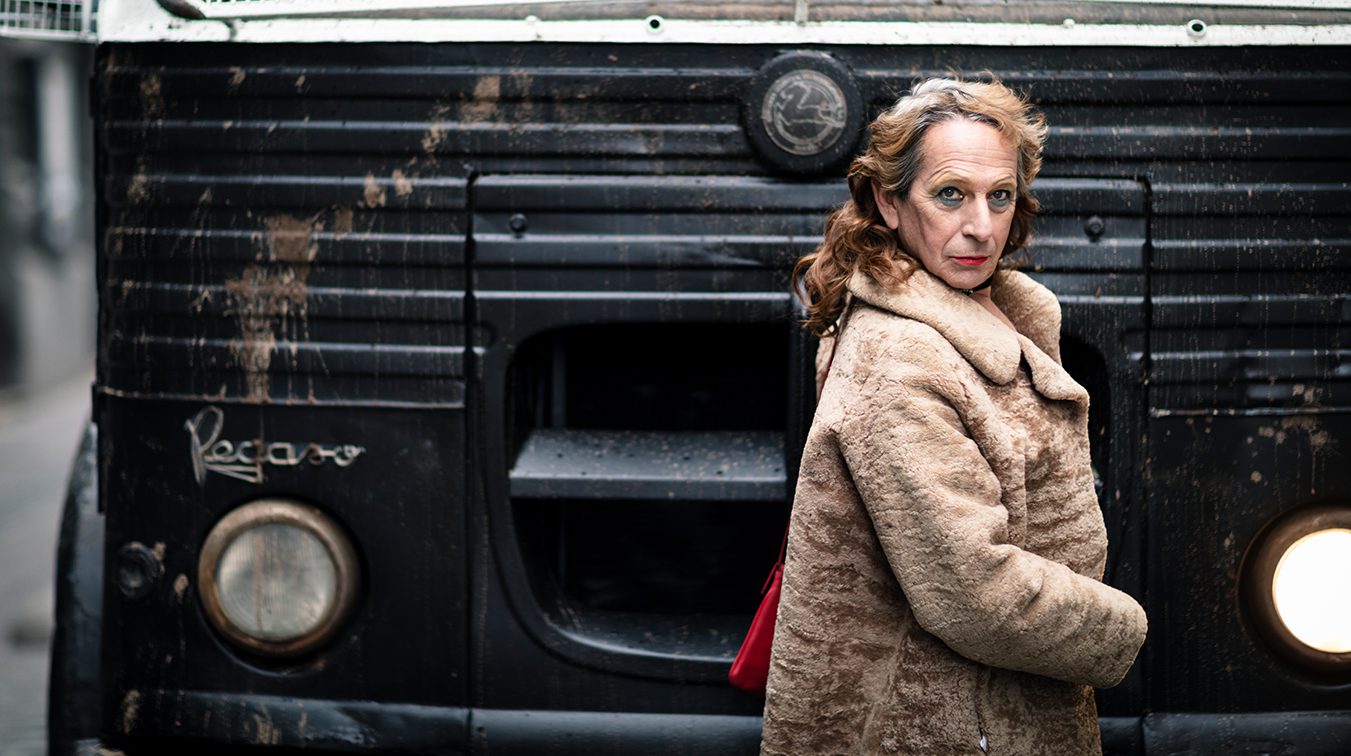
It is very important for me to situate the film at the time where the novel is based, which is 1986, one year after the earthquake. In the middle of the dictatorship, with absolute repression, with a curfew, with the military on the streets ... and bring out that very poor and marginal Santiago in which they lived. For that they were crucial Marisol Torres in the Art Direction, Caro Espina in Wardrobe and Sergio Armstrong in Photography -with whom I have already worked before and we get along very well-; then basically the challenge was how to show, how to create and understand the look of that Santiago of the eighties.
-In the trailer we see Alfredo Castro transvestite making a faithful interpretation of the Loca del Frente, how did you come up with this character?
There was an enormous work into creating Alfredo's character, and the Loca del Frente is in 98% of the scenes in the movies, he is in everything, so it was very important to work and define what that character was like in every way. To understand, for example, that five to six different human beings coexist within it. There is the Loca of the public world where she prostitutes herself in a cinema, where she has to dress for such effects. There is the Loca who walks the streets of a dangerous and homophobic Santiago, who has to dress like a man. There is the Loca from the private world, one that belongs to herself and her alone, where she embroiders the tablecloths, but there is also the Loca who slowly falls in love with Carlos and gets dressed and groomed for him. There is the Loca that sings and dances. There are many characters and that was a very nice job, the creation of those costumes, those makeups, those hairs, the voice work, the movements of Alfredo to give life to those multiple Locas who live within the character .
-Lemebel demonstrated the importance of music in his books, in his work (radio) and in his activism. How important is the sound in the film? Could you tell us how was the work done with Pedro Aznar and the creation of the soundtrack?
The music in the film was very important. Pedro Lemebel worked in radio, he knew a lot about music as well. In fact, Tengo miedo torero is a bolero, a song that Lola Flores sang in the fifties. Pedro Aznar did a remarkable job, and he also sings along with Manuel García a very beautiful song called Si no hablamos. There is also Diego el Cigala with Eva Ayllón who sing the bolero Tengo miedo torero. There is María Felix, there is Gal Costa, there is an endless number of musicians that Lemebel liked very much and that are also part the film. And there is also the soundtrack, which is what Aznar did, that accentuates and points out specific moments in the film. It is a soundtrack that creates the entire sound atmosphere of this film.
-Problems such as, for example, poverty or misery are universal, but how do you think the political context of this film can echo in today's Chile?
The political context is extremely important in this film and especially with what was experienced afterwards. We were in July 2019 recording demonstrations that took place in the 80s, in the center of Santiago, and the youngest team asked Alfredo and me, what was that time like, what was the repression like, what were the demonstrations like and it turns out that three months later the social outbreak in Chile happened and the same thing we had been filming was being lived: guanacos (water cannons) throwing water at people, police repressing protesters, etc., The film was ahead of what was happening as did the figure of Lemebel in the streets, during the protests of the 80s. Therefore, the context is extremely important and relevant to what we are experiencing today.
-Alfredo Castro has repeated in many interviews that his character is not Pedro Lemebel, but a fiction. Is there any other aspect or reflection that you would like to share regarding the film and the expectations it has generated?
Yes, during this interview, it came to me the importance of understanding that novels are novels and movies are movies. This is an adaptation of Pedro Lemebel's novel, Tengo miedo torero, but as a team, and me as the director and writer of the adaptation, we have tried to be as respectful as possible of the world that Lemebel created and wrote about. I believe that the public is going to find that: the world of Pedro Lemebel, with the essence of Tengo miedo torero and of course with some differences as well.
-To round up, the premiere in Venice will be the beginning of the world tour of the film, how do you expect its reception? Are you worried of what the current situation could generate (confinement, global pandemic)?
It is always good news that a film begins its journey in such an important place, with as much tradition as the Venice Festival and in particular Giornate degli Autori. It is just good news for us as a filmmaking team! So the films will start to walk alone, it has to go to other festivals ... we do not know how it will be released in Chile, in what format, and where else, but this international premiere in Venice is something not only important, but also very beautiful. Where and how to continue afterwards, well, borders and barriers will open, and there we will discover these new ways. I hope so, and it is a commitment that we have as a team, that the film in Chile will also be present for the Lemebel audience: in public places, in squares, in the provinces, where cinema in general, our cinema, does not arrive massively. That is a commitment, that this film can be watched in many places, not only in the most traditional ones.