
Despite the global pandemic that has affected the world for the last six months, there are still some elements of the film industry that haven’t changed: for yet another year, the San Sebastián Film Festival gives a warm and enthusiastic welcome to Chilean cinema. With 4 films in official selection of the festival, 3 projects in-development in industry spaces, and 1 series in parallel screenings, national talent shines despite global difficulties. Cinema and art have proved to be an oasis in these turbulent times, an important place of encounter and reflection, and we invite you to discover the way in which Chilean cinema and the San Sebastián Film Festival are managing to reach global audiences during the era of Covid-19.

4 FILMS IN THE OFFICIAL SELECTION!
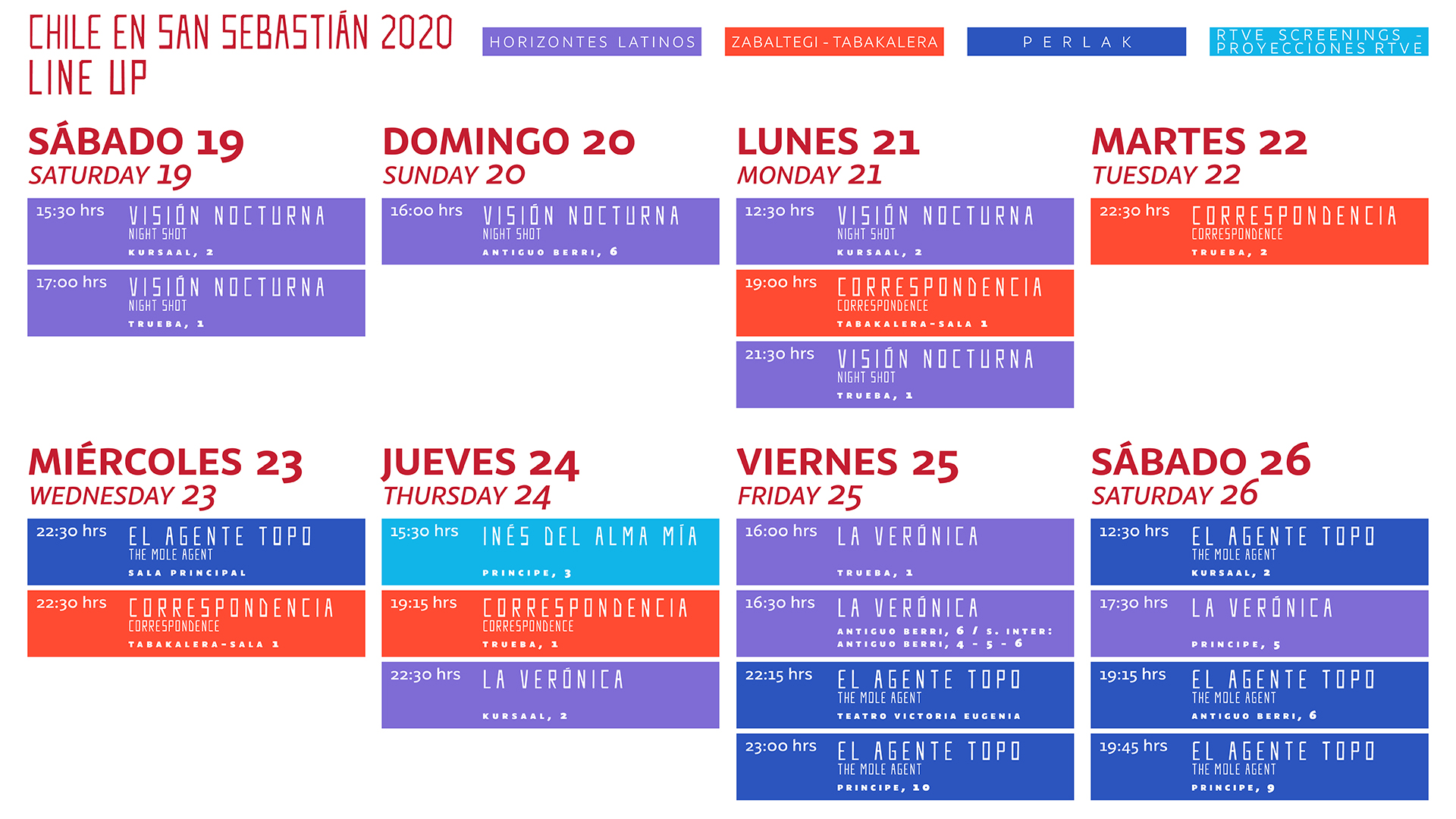
After an incredible trajectory in Sundance, Miami, and Docaviv, The Mole Agent by Maite Alberdi (Tea Time) arrives to the Perlak section at San Sebastián, a space that rounds up the most awarded and critically acclaimed films annually. Exhibited along with winning films from Berlin (Never Rarely Sometimes Always) and Venice (Nomadland), The Mole Agent has proven to be one of the most important films of 2020, transcending the boundaries of documentary and fiction and delivering a moving filmic narrative. In the meticulous visual style characteristic of Alberdi, the film follows a private detective who investigates a case inside a retirement home. Co-produced between Chile, the United States, Spain, the Netherlands, and Germany, Alberdi’s fourth film positions her without a doubt as one of the most important directors in Latin America.
Constanza Arena, executive director of CinemaChile, and who this year will form part of the Eurimages Award jury (Europe-Latin America Co-Production Forum) details: “The Spanish audience adores Maite and has followed her entire career. Let’s remember that Maite was nominated to the Goya Awards for the film Tea Time, and for CinemaChile it’s a tremendous honor to return to audiences to present them with this film by such an outstanding director.”
Another national film that has swept the international stage, obtaining the Grand Jury Prix at FIDMarseille, is Night Shot, that now lands in San Sebastián to compete in the Latin Horizons section. The first feature by Carolina Moscoso, the documentary explores, in a video-diary format, the wounds left by abuse and the revictimization brought about by judicial processes. In the film, friendship is seen as a refuge, a form of salvation from the patriarchal violence experienced by women. Moscoso’s approach, bravery, and talent make her an important new voice in Chilean cinema, transmitting an intimate narrative that is sure to resonate with Spanish audiences.

Another important milestone for Chile in the Latin Horizons section is the world premiere of La Verónica by director Leo Medel, a fiction starring Mariana Di Girolamo (Ema), who portrays a popular model on social media. For more than ten years, Medel has sought the possibility of a cinematic narration where each scene is made up of only close-ups, exploring the universality and incomprehensibility of the human face. Here he manages to do so, and Di Girolamo shines with her potent, emotive acting. Having premiered his film Hotel Zentai at the Raindance Film Festival in 2018, Medel returns with this gripping pop thriller about the connection and disconnection produced by virtuality.
Another filmic event that has caused a stir in the international industry is the premiere of the first film by Dominga Sotomayor after winning the award for Best Direction at Locarno 2018 with Too Late to Die Young. Now she returns with a dreamy collaboration of sensibilities with Spanish director Carla Simón (Summer 1993). Correspondence is constructed in letters sent to one another during the pandemic, tracing pieces of their lives and reflecting on cinema, family, inheritance, and maternity. An epistolary short film participating in the Zabaltegi-Tabakalera category, a space that programs risk-taking films, Sotomayor and Simón’s profound meditations outline a country’s political emergency.
3 PROJECTS IN-DEVELOPMENT and 13 PRODUCTION HOUSES ARE PRESENT!
As always, this year we have an enormous presence despite the hybrid format, which will be in-person and online, establishing connections and experiences that range from the computer screen to the theater. A delegation of 13 production houses stand out in the industry arena, a place where Chilean films of the future begin to be developed and financed.
Arena highlights the importance of participating in this event during this global context, and the need to bolster the audiovisual sector in an era in which the planet had never before lived, asserting that “at CinemaChile, we’re seeking to drive the audiovisual sector at times of global crisis, a sector that is fragile, given that the pandemic has particularly affected the possibility for filming and reactivating the industry. We’ve ended up in a very precarious situation, so recurring to the international market, to festivals, to connecting with audiences, and to [obtaining] financing and support of foreign origin, are today more than ever of vital importance.”
One of the central pillars of San Sebastián that is reactivating the industry is the Europe-Latin America Co-Production Forum. Delirium by Alexandra Latishev is participating in this selection, a project produced by La Linterna Films (Costa Rica) and CYAN (Chile), a production house led by Cynthia García Calvo. Set in Costa Rica in the ‘90s, Delirium tells the story of a girl who, after spending a time living outside of the country, returns to the home of her grandmother, who is losing her memory. Her first film MEDEA, also co-produced by CYAN, was screened in festivals such as San Sebastián, Warsaw, and BAFICI, and was nominated for a Fénix Award.
Meanwhile, WIP Latam is the new work-in-progress section of San Sebastián Film Festival and will substitute Cine en Construcción. This year, it will be held in mixed format, but with the same objective: to support the production of Latin American cinema for the completion of films in the post-production stage. Chile will be present with Piedra Noche by Iván Fund (Argentina, Chile), a family tragedy that mixes elements of drama, nostalgia, and fantasy. It is produced in Argentina by Rita Cine and Insomnia Films, and in Chile by Globo Rojo Films, a production house led by Catalina Vergara and that recently stood out with Death Will Come and Shall Have Your Eyes (San Sebastián, 2019) and The Wolf House (Berlinale, 2018).
Additionally, the first feature film in development by Diego Céspedes, The Mysterious Gaze of the Flamingo, lands in San Sebastián after intense weeks of workshops as part of the Ikusmira Berriak residency program. After winning Cinefondation at Cannes in 2018 with The Summer of the Electric Lion, Céspedes prepares his first feature with producer Giancarlo Nasi of Quijote Films. During the last phase of the residency, together they are fine-tuning the project about an unknown illness affecting a mining town in Chile, in order to pitch and secure meetings with industry professionals present at the Festival.
TV SERIES: NEVER-BEFORE-SEEN AT THE FESTIVAL
The effervescence of Chilean series arrives in San Sebastián with Inés of My Soul, following its attendance at Conecta Fiction Reboot, and will be present in parallel projections organized by Corporación de Radio y Televisión Española, RTVE. Directed by Alejandro Bazzano of Spain and Nicolás Acuña of Chile, the series is a moving historical drama set in the 16th Century, based on the book of the same name by Isabel Allende. It follows Inés Suárez (Elena Rivera), a young Extremaduran during the colonial age who crosses the Atlantic in search of her husband (Benjamín Vicuña). The production includes multiple national actors, among whom is Antonia Giesen (The Pack).